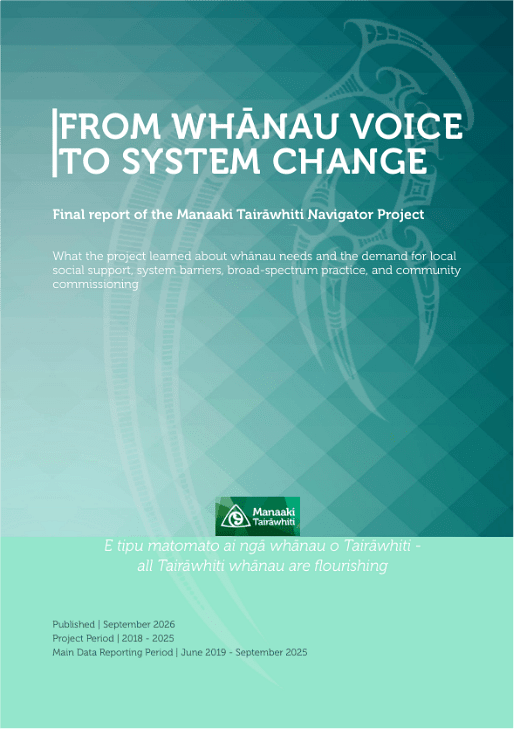
Whānau in Tairāwhiti facing complex challenges were having to navigate a fragmented system of services that did not always work together. Manaaki Tairāwhiti was established under iwi leadership in 2015 to address that familiar problem, bringing together iwi, community organisations and government agencies. Its development in Tairāwhiti offers one of Aotearoa's most interesting examples of place-based social investment.
Its recent report, From Whānau Voice to System Change, provides a valuable account of what the initiative has learned – and some important clues for the Waikato as we explore our own approach to social investment.
At the heart of Manaaki Tairāwhiti was a network of local Manaaki Navigators, or Kaiurungi, working alongside whānau to understand their circumstances, coordinate support, advocate for them and help overcome barriers between services.
The project systematically recorded what whānau needed, the responses they received and where the system was failing them. Between 2019 and 2025, it supported 1,542 whānau and recorded 8,299 demands for support. Whānau presented with an average of 4.6 needs or concerns, often spanning housing, health, income, education and employment. Just over half of the whānau encountered at least one system barrier.
The findings reinforce an important point: people's lives do not fit neatly within the boundaries of individual agencies, services or funding programmes.
Navigators were often able to resolve immediate problems, particularly when they had access to flexible support. Yet many of the same barriers kept recurring: in nearly half of the whānau journeys analysed, some or all recorded needs remained unmet. The report is positive about the Navigator approach's value, but candid about its limitations.
The lesson is that helping people navigate a fragmented system is not the same as fixing the system itself.
Manaaki Tairāwhiti's next ambition is for local leadership to have greater influence over how services are designed, funded and delivered, using evidence about what whānau actually need. This is community commissioning. The report recognises that the transfer of decision-making authority is still a work in progress.
What might this look like in the Waikato?
The Manaaki Tairāwhiti experience points beyond better referrals and collaboration. This work needs reliable evidence about people's experiences and the system barriers that keep recurring. Ultimately, it needs a way for that local insight to influence how resources are allocated and services are commissioned.
We are not looking to replicate the Tairāwhiti model. The Waikato has its own organisations, relationships and circumstances. But its experience provides a valuable guide to both the possibilities and the challenges.
Can the Waikato move from organisations responding to wellbeing challenges individually to a more coordinated local response? That response would need to draw on the experiences of people affected and be able to influence where investment goes and what it achieves.
Read the report: From Whānau Voice to System Change – Manaaki Tairāwhiti Navigator Project
https://mt.org.nz/wp-content/uploads/Navigator-Report-October-2026-FINAL-Online-Digital.pdf
