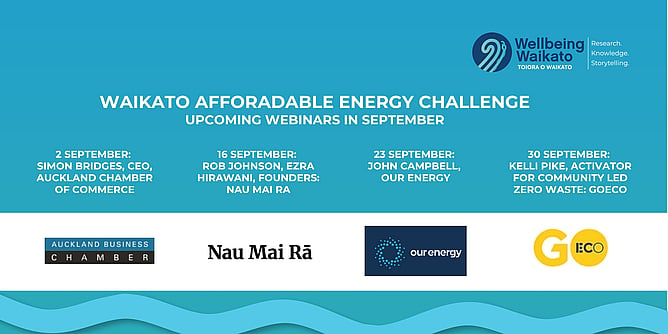
The Waikato Affordable Energy Webinar Series1 was established to build a shared, evidence-based understanding of New Zealand’s electricity system at a time when affordability pressures are becoming increasingly visible for households, businesses, and communities. The intent is not to reach a single agreed position, but to surface where there is convergence, where there is contest, and what this implies for practical pathways forward.
Across the series, a consistent message has emerged: New Zealand is not constrained by energy scarcity, but by system design, coordination, and the way costs and risks are distributed across time and participants in the system.
Core System Reality: Abundance Within a Complex System
New Zealand has a strong generation base, including hydro, geothermal, wind, solar, and thermal backup, with the Waikato sitting at the centre of the national system through hydro generation and network infrastructure.
However, this abundance exists within a system that is increasingly complex and in transition—from a centralised, dispatchable model to one with greater variability, decentralised generation, and tighter interdependence between generation, networks, and retail markets.
The result is a system that is technically capable but increasingly difficult to coordinate efficiently. Across the series, affordability pressures are therefore not seen as a scarcity problem, but as an outcome of system structure, governance, and investment design.
Emerging Areas of Agreement
Despite different perspectives, several areas of convergence are clear. Affordability is understood as systemic rather than purely price-driven. Electricity prices reflect long-term infrastructure investment, risk allocation, and market design rather than short-term fluctuations.
There is also broad agreement that long-term policy stability is essential for investment confidence, and that electrification of transport and heat is already underway and likely to accelerate. System flexibility is increasingly seen as essential, requiring demand response, storage, smarter pricing, and better integration of distributed energy resources.
Points of Tension
Key tensions remain between those who see the current market structure as broadly functional versus those who argue deeper reform is required. This includes differing views on wholesale pricing, gentailer roles, and whether current settings embed structural upward pressure on prices. There is also ongoing debate about centralised versus decentralised investment pathways, and how costs and risks should be distributed across the system. There is also considerable ongoing debate about how to ensure system reliability, between those who see the need for larger scale firming’ (such as via thermal assets or imported LNG), and those who see this better achieved via distributed storage systems (e.g. batteries) and other forms of energy storage and demand re-distribution. There is a non-insignificant group in the middle who see the need to retain some thermal generation backup as well as a much more distributed and locally generated system.
Finally, there is a growing recognition that complexity itself is a barrier to affordability, limiting consumer agency and weakening the effectiveness of market signals.
Emerging Pathway Forward (strengthened by recent sessions)
A consistent direction is emerging across the series: the need to expand low-cost generation, enable demand-side flexibility, and improve long-term system coordination to reduce investment uncertainty and improve affordability outcomes. Speakers since our last newsletter included:
Manu Barrett (Solar Sense)
Highlighted that energy hardship is a system outcome, not just an income issue, sitting at the intersection of housing quality, pricing, and household resilience. This reinforced the importance of place-based, coordinated responses rather than fragmented interventions.
Qiulae Wong (The Opportunity Party)
Emphasised that affordability pressures reflect structural system design choices rather than short-term distortions, reinforcing the case for more fundamental reform discussions rather than incremental adjustment alone.
Barney Irvine (Auckland Chamber/Northern Infrastructure Forum)
·Reinforced that electricity is increasingly a constraint on economic growth, with supply expansion and infrastructure investment lagging behind demand pressures driven by electrification and system transition.
Paul Fuge & Jessica Walker (Consumer NZ)
Highlighted that while markets are formally competitive; complexity, information gaps, and switching friction significantly limit effective consumer participation.
Rob Johnson (Nau Mai Rā)
A key insight was that affordability is not only determined by generation or wholesale prices, but by retail design and value distribution within the system. Their model demonstrated that affordability outcomes can be materially reshaped through how value is structured, shared, and returned to households, particularly those in vulnerability.
John Campbell (Our Energy)
Reinforced the paradox of energy abundance alongside persistent energy hardship, arguing that the binding constraint is not supply but coordination, transparency, and system accessibility. Electrification was framed as a whole-of-system transition requiring alignment across infrastructure, pricing, behaviour, and governance, with trust and clarity as critical enablers.
Interim Synthesis
The webinar series will continue until mid-November. Across the series so far, five key conclusions are emerging:
New Zealand’s electricity challenge is primarily about system design and coordination, not resource scarcity.
Affordability cannot be solved through price intervention alone, as costs are structurally embedded in long-term system design.
Electrification and decentralisation are already underway and need active shaping to ensure equitable outcomes.
There is no single solution pathway—multiple levers across generation, networks, markets, and demand will be required.
Energy policy is increasingly a core wellbeing issue, directly affecting housing affordability, resilience, health, and economic performance.
For the Waikato, the opportunity is to translate these national insights into practical regional action, particularly where energy, housing, and wellbeing intersect.
The series continues with further contributors across community energy, industry, governance, and policy, including GoEco, Community Energy Network, Mercury, New Zealand First, and Waikato Regional Council. These sessions will further test and refine the emerging system picture.
Final Synthesis
A full synthesis report will consolidate insights from the series alongside recent national work on energy affordability. Its purpose will be to move beyond individual perspectives toward an integrated view of system trade-offs and practical choices for the Waikato, including where regional action can add value and where national change is required.