Our Business Plan proposed that Wellbeing Waikato could support the development of a place-based, integrated social investment approach for the Hamilton city centre, both in its own right and as a possible model for other localities in the Waikato. Drawing on New Zealand’s social investment principles—targeting resources to those with the highest needs, using data and evidence to guide investment, collapsing resource competition and duplication and focusing on long-term wellbeing outcomes.
Our role would be to bring funders, iwi, providers and local government together around a shared understanding of need, informed by both data and whānau voice and to support the development of a collective outcomes framework for a defined population cohort. This would shift the system incrementally from fragmented, provider-led activity toward more coordinated, person-centred support.
Progress to Date
We have continued to work alongside Trust Waikato and a small project team to develop a way forward for Social Investment. Following on from the Social Investment Summit in late 2025, and initial discussions in early 2026, Wellbeing Waikato offered to develop an agreed foundation document to make sure all stakeholders were equally informed about Social Investment- what it is, where it comes from, its strengths, weaknesses and current operating model in New Zealand.
Social Investment Background Report
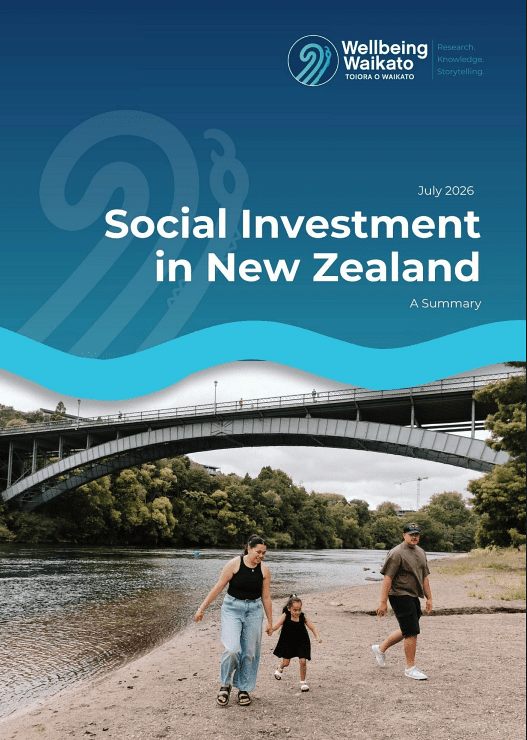
In August we released our report “Social Investment in New Zealand, A Summary” The report concludes that Social Investment in New Zealand is increasingly understood not just as a funding model, but as a shift in how the system organises itself around outcomes, evidence and prevention.
The report traces its evolution and clarifies its core intent: to move from reactive, fragmented spending toward earlier, more coordinated investment that improves long-term wellbeing.
The report emphasises that while national frameworks (including the Social Investment Agency) set direction, the real test is whether the approach can be made operational at a regional level. In the Waikato context, this means moving beyond concept to practice: shared outcomes across agencies and funders, stronger alignment between central and local government, and a much clearer role for iwi, philanthropy and community providers in shaping and delivering investment decisions.
Social Investment Blog Series
In August, we produced and shared a 6-part blog series on Social Investment on LinkedIn. The series reinforced that Social Investment will only become real in the Waikato if four conditions are met. First, a shared regional outcomes framework that is meaningful to communities, not just government reporting. Second, genuine data integration that connects lived experience and whānau voice with administrative and service data in ways that support action, not just measurement. Third, long-term, place-based commissioning that reduces short-term contracting cycles and enables continuity of relationships and interventions. And fourth, distributed leadership across the region—so councils, iwi, funders and community organisations jointly steward outcomes rather than operate in parallel systems.
A consistent theme from the previous research captured in the paper, and feedback to the LinkedIn series, is that Social Investment is not a technical fix; it is an organising framework for collective action. Its value depends on whether it can shift behaviour—earlier intervention, better coordination, and sustained investment in what works—while still recognising structural drivers of disadvantage such as housing, income, energy and social connection.
Key Messages and Next Steps
Overall, the report positions Social Investment as a significant opportunity for the Waikato, but only if it is translated into a deliberate regional operating model that aligns funding, data, leadership and accountability around shared wellbeing outcomes.
The next stage is to explore what people and community centred Social Investment in the Waikato could mean in practice. A project plan is currently under development with the Trust Waikato-led reference group.