As well as our own channels, public fora and FreeFM, Wellbeing Waikato also regularly contributes via other media.
Here are several examples over the past 2 months:
A. Regional Economic Development in the Waikato.
A short article authored by Harvey and Dr David Waite of the University of Glasgow, published on their Glasgow Social Sciences Hub. This paper argues that the long-standing separation of “urban” and “rural” thinking in New Zealand is increasingly unhelpful, particularly in regions like the Waikato where cities, towns, and primary production are deeply interconnected. Instead, it proposes a shift toward understanding the Waikato as a single, integrated system shaped by flows of people, firms, infrastructure, and ideas across space.
Using the Waikato as a case study, the paper suggests that regional prosperity depends on recognising these interdependencies and designing policy that supports both urban innovation and rural production, rather than treating them as separate economic worlds. It also emphasises that wellbeing outcomes—such as housing, energy affordability, and access to opportunity—are now central to regional development, alongside traditional economic growth measures. The article can be seen here: University of Glasgow - Explore - Glasgow Social Sciences Hub - Resources - All resources - Looking past the urban vs rural dichotomy
B. Hamilton’s Identity and Reputation:
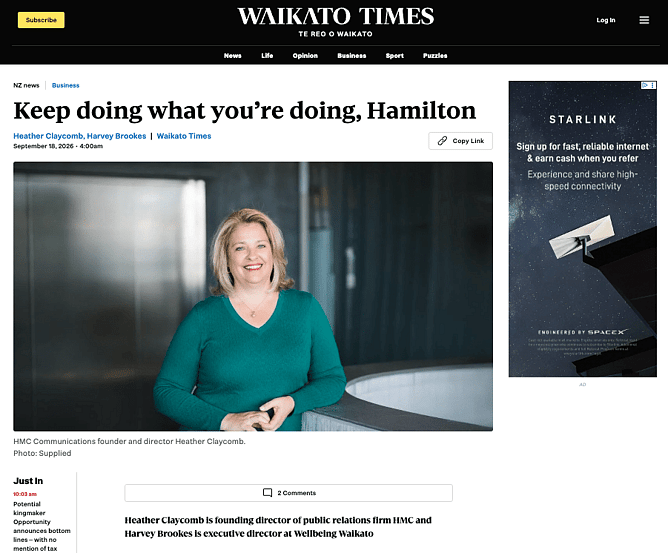
This article was co-authored with Heather Claycomb of HMC Communications and published in the Waikato Times. It argues that Hamilton does not need to “market itself better” or seek external validation but instead should focus on continuing to build a confident, high-functioning city that speaks for itself. The authors suggest that outdated perceptions of Hamilton persist largely because of old narratives, not current reality, and that the city is already performing strongly in terms of growth, liveability, and economic potential.
Rather than relying on branding or image campaigns, the article emphasises that reputation is shaped by substance: investment, talent attraction, cultural confidence, and everyday lived experience. In this framing, Hamilton’s task is not to be liked, but to keep improving and allowing its own momentum, character, and achievements to reshape external perceptions over time. The article can be seen here (paywalled): Keep doing what you’re doing, Hamilton | Waikato Times
C. Adverse Events and Systemic Failures:
This article explores the concept of “normalisation of deviance”—first identified by sociologist Diane Vaughan in her analysis of the 1986 Challenger disaster—as a way of understanding how systems drift into failure not through a single mistake, but through repeated acceptance of small departures from expected standards.
Drawing on examples from the Space Shuttle Challenger and Columbia disasters, it shows how early warning signs were observed but gradually reinterpreted as acceptable because nothing catastrophic had yet occurred. The same pattern is then applied to recent infrastructure and governance cases in New Zealand, where known risks and early signals were progressively normalised until they became embedded in “business as usual.”
The central argument is that systemic failure is rarely sudden or mysterious; it is often the endpoint of slow, incremental drift in which institutions adapt to risk until it no longer feels like risk at all. The article can be seen here: What the Normalisation of Deviance Tells Us that Systemic Failure Can’t | LinkedIn