Wellbeing Waikato (and previously Wellbeing Waikato Project) has been actively involved in improving housing affordability since 2021. We have supported regional leadership groups such as the Waikato Housing Initiative to better understand the current situation through a housing dashboard and a stocktake of the current number of homes being built, compared to the projected future demand.
In 2025, we further explored the current state of affordability in the region in a report “Hiding in Plain Sight: The Real Cost of Housing Affordability in Waikato Region.” The report found that Housing in the Waikato has shifted from broadly affordable in the 1990s (around 3× income) to structurally unaffordable today, with prices now exceeding 6× incomes and increasingly disconnected from what people earn.
This has dramatically extended the time needed to save a deposit—from manageable levels historically to around 13 years today, and potentially 20–28 years in future if trends continue. The report concluded that without structural change, homeownership will become progressively out of reach, deepening inequality and reshaping the region’s social and economic fabric.
Building on this, in late 2025, Wellbeing Waikato with funding support from Futureproof, commissioned Veros to identify actions which would make housing more affordable for families earning around the median household income, looking to buy a median priced house.
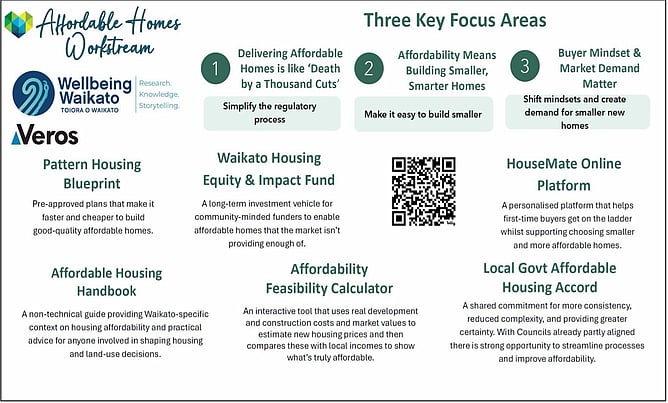
The Housing Affordability Challenge reports focus on a set of six system-level actions that, taken together, provide a practical roadmap for change. They reframe affordability in operational terms and identify which interventions will have the greatest leverage: establishing a shared definition of affordability tied to real incomes; using consistent affordability modelling to guide decisions; unlocking land and infrastructure through coordinated planning; scaling standardised “pattern housing” to reduce cost and complexity; aligning local government settings to support delivery at the right price points; and creating new funding vehicles, including a Housing Impact Fund, to bridge the gap between feasibility and delivery. The strength of the report is not just in the ideas themselves, but in how they connect—each action reinforcing the others to shift the system as a whole.
The diagram below shows the three key issues found by the report, and the six ideas developed and shared. A more detailed booklet on each of the six proposals can be found on our website here.
For policy makers and funders, these create a clear and credible pathway from insight to impact. Rather than dispersing effort across disconnected initiatives, the six actions define a set of aligned investment opportunities where capital can accelerate change—whether by underwriting enabling infrastructure, supporting scalable housing solutions, or anchoring innovative financing models. The final report and recommendations of the research were presented to and fully endorsed by the FutureProof Implementation Committee in June. We have followed this up by writing to every Mayor and council CEO in the region, sharing the work and encouraging them to adopt its findings.