We are delighted to be partnering with Community Waikato and Free FM and Community Waikato to present a monthly discussion on data and what it means. Every month Harvey will sit down with Community Waikato CEO Holly Snape, to explore a current topic and look carefully at what the data says, what it means for the Waikato and how people can get involved.
You can listen to the stories so far here. A big thanks to Holly for inviting us to join the korero.

July 2026: Population Change
In July Harvey spoke to Holly about demographics, and how changes in population dynamics will profoundly reshape human society, in the Waikato, New Zealand and globally.
Most of us carry around a very old mental model about human population—we tend to think it just keeps growing, almost like a virus, accelerating until it hits some kind of crisis point. That Malthusian instinct is deeply ingrained, but it turns out it’s not a very good guide to what’s happening.
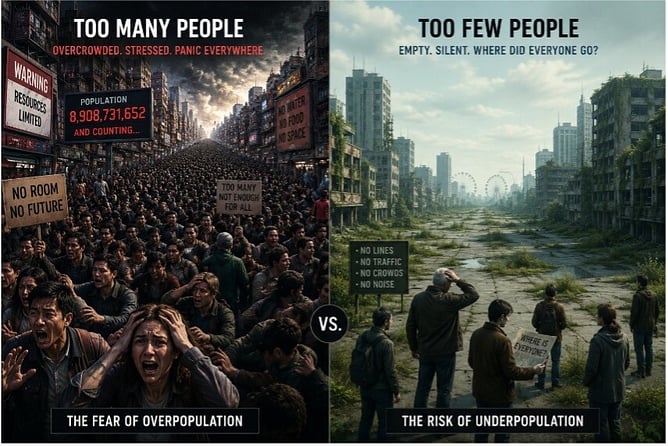
If you want a good challenge to that intuition, an accessible place to start is Darrell Bricker and John Ibbitson’s book Empty Planet: The Shock of Global Population Decline[1] which makes the case that the bigger long-term risk may be population decline rather than explosion.
If you step back and look at how population really works, it’s driven by three things: how many children people have, how long they live, and how many people move in and out of a place. Those are the same core variables used in formal demographic models—fertility[2], mortality[3], and migration[4]—and they’re the foundation of most serious analysis, including work by New Zealand Treasury. The important point is that these drivers are changing in quite structural ways. Fertility is falling, life expectancy is rising, and migration is becoming the swing factor in many countries.
You can see that clearly in New Zealand. While our population has grown strongly over time, the rate of growth has slowed markedly. That’s not unique to us—it’s a global pattern.
New Zealand’s rate of population growth peaked in the 1960s and has been declining ever since, largely because fertility rates have dropped, currently sitting at 1.67. At the same time, people are living longer (life expectancy is now greater than 80 -in 1948 it was 68), which means populations are ageing. Treasury’s recent analytical work[5] makes this point very clearly: New Zealand’s demographic future is increasingly characterised by an older population, lower fertility, and a much greater reliance on migration to sustain numbers.
What that creates is a slightly deceptive picture. Population can keep increasing in absolute terms for quite a long time—even when the underlying dynamics have shifted—because of what demographers call “momentum.” But underneath that, the trajectory is already bending. If you look at the global evidence base—particularly the United Nations’ World Population Prospects 2024[6], the consensus view now is that population will peak later this century and then begin to decline. And importantly, those projections are being revised: the peak is continuously being brought forward and the total size revised down as fertility falls faster than expected.
And this is where it gets interesting. Most people don’t perceive that shift, because it’s slow, it’s compounding, and it runs counter to our instincts. We see more people around us and assume the trend continues indefinitely. This might be because more of us are living more closely to each other in urban areas- we feel crowded. But the structural drivers are already moving in the opposite direction.
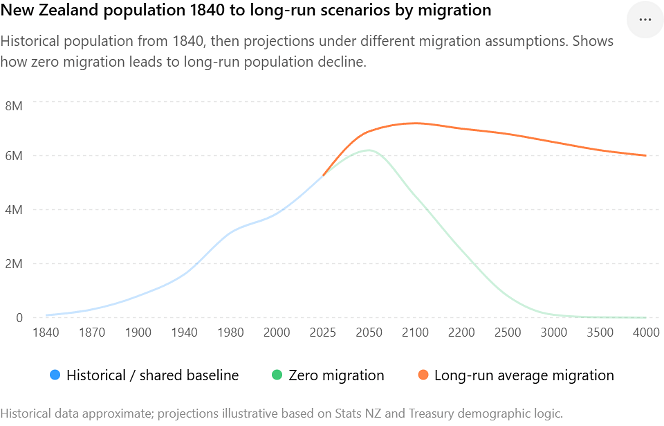
If you take that seriously, it flips the policy conversation. The long-term challenge may not be too many people, but too few—fewer workers, more fiscal pressure, and real questions about how you sustain health systems, superannuation, and economic growth. Treasury modelling goes as far as to show that, under sustained sub-replacement fertility, population decline becomes inevitable and even starts to approach zero in the long run, in the absence of migration. That one fact should change how we talk about migration policy. In a world where people become a scarce resource, how will New Zealand attract the best people to come and make their home here?
[1] EMPTY PLANET : BRICKER, DARRELL: Amazon.com.au: Books
[2] Fertility rate: the average number of children a woman is expected to have over her lifetime, given current age-specific birth rates. For a population to remain static (excluding migration), the fertility rate needs to be 2.1
[3] Mortality rate: the frequency of deaths in a population over a given period, typically expressed as deaths per 1,000 (or 100,000) people per year.
[4] Migration: the movement of people into (immigration) or out of (emigration) a defined population, contributing to changes in its size and composition. Net migration is the product of immigration and emigration.
[6] https://www.un.org/development/desa/pd/world-population-prospects-2024?utm_source=chatgpt.com
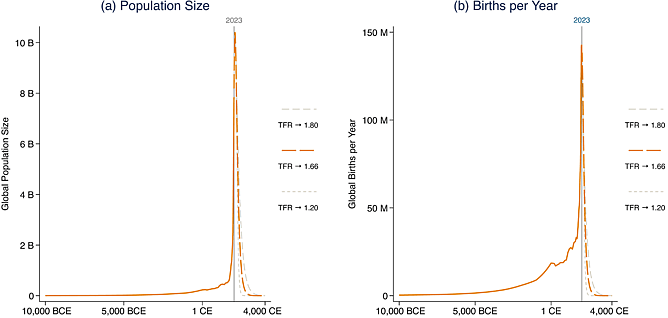
If that sounds like a very different world in the future- you’re right! A paper by Spears et al[1] in 2024 looked at these trends on a global scale and projected possible long term (1thousand years in the future) populations. Even if global fertility rates settled at about 1.8, the global population of humans by the year 3,000 could be very low- less than 100m- about 1% of the current population.
[1] Long-term population projections: Scenarios of low or rebounding fertility | PLOS One
So the takeaway is this: population isn’t behaving the way we intuitively think it is. The curve is still going up—but it’s flattening, and over time it’s likely to turn. And most of that shift is already locked in. The real challenge now isn’t just understanding that change but planning for it—because by the time it becomes obvious, it will already be well underway.
